Sunday, November 30, 2014

|| Shree Hari ||
Manas Mein Naam Vandana - 2
मानसमें नाम-वन्दन

continued......

The saint thought,   that I must teach him a lesson.   So he disguised himself as the “Seth”, and went to the “Seth’s”  house.   The gatekeeper said -  ‘How come Sir you are home so early today?’  He said,  that ‘a polymorphic is disguised as me and is coming towards the house.  I thought that he might be up to some mischief,  therefore I came home early.  You be careful !  If he comes here,  do not let him in.’   

Just as the owner was doing his routine rituals,  similarly, this saint (disguised as the Seth) began to do worship of the Lord and daily scripture reading.   Now the Seth just like he normally did,  came in his ‘dhoti’  carrying a water container.    The guard stopped him.   ‘Where are you going?   Stay away from here !   The Seth said -  ‘Have you had some “bhaang” (a sort of opium drink)?  Are you drunk or what?   What is the matter with you  ?   You are my servant, and I am your master.’  The gatekeeper said ‒‘Get away from here,  you cannot enter the premises’   The Seth called out for his kids ‒‘What is the matter with this gatekeeper today?’ Then he heard the children saying  ‒‘go away,  do not come in’.  Whoever he called out to,  they all disregarded and pushed him away.    The Seth saw,  that what sort of drama is going on brother ?  I am unable to even enter the gates of my own house.   The poor man began to wander here and there.  

Now what am I to do ? When no where was he acknowledged,  he went to the king’s palace and filed a report,  a complaint, that I have encountered this troubling situation.   The Seth was highly honored in the kingdom.  When the king saw him in this state,  he said ‒‘what do you have to say today ? How is it that you have come here in your “dhoti”  carrying you water flask ?’   He said ‒ ‘O’  Maharaj  ! Some stranger has disguised himself and entered my home, and has thrown me out.    The king said ‒‘you used to come here in a chariot with four horses.  Today,  your condition has deteriorated to such an extent !’   The king asked his men to go and investigate the situation and find out about the fake man.  When they went to the Seth’s house,  the family said,   the fake guy went to meet the king  !  Our Seth is sitting inside.  The king was informed that the Seth was sitting comfortably at his home.   The king said to tell the Seth that the king is inviting him.     Now the Seth,  came in a chariot with four horses,  like he used to visit before and said  ‒ ‘Oh!  sustainer of all !  Why have you remembered me today?   What is the issue ?  

The king was baffled,  seeing them both looking so alike.  How is anyone to tell the real one ?   On asking the minister,   they said,  they are unable to figure out who is the genuine Seth.   Thereafter the king asked ‒‘who is the genuine one of the two and who is fake?    Then they said ‒‘you may test us’ the saint who had become a Seth said ‒‘Bring the register.   I will tell you what is written in the register.”  The registered was brought in.  The saint who was disguised as a Seth,  he without seeing said that in such and such a year,  that a particular building so much money was spent.   So much was spent on “ghee”  and that much on weddings.   All that was recorded in a particular register.   They were able to trace all those figures in that particular register.  The Seth was totally awed.   He did not remember any such details.    From this it was proven that he was the fake Seth.  Therefore it was ordered to  be sentenced with a punishment.   But due to the request of the saint,  he was released.    

From  Book in Hindi “Manas Mein Naam Vandana”  by Swami Ramsukhdasji  
|| Shree Hari ||
Manas Mein Naam Vandana - 2
मानसमें नाम-वन्दना
yashoda-maiyya-baal-krishna-01.jpg

‘जग पालक बिसेषि जन त्राता’‒  On the subject of pride of wealth,  a poet has said something unique ‒

हाकम जिन दिन  होय  विधि  षट्  मेख  बनावे ।
दोय  श्रवणमें  दिये  शबद   नहीं  ताहि  सुनावे ॥
एक मेख मुख माय   विपति  किणरी  नहीं  बूझे ।
दोय मेख चख मांय   सबल  निरबल  नहीं  बूझे ॥
पद हीन होय हाकम  परो छठी मेख तल द्वार में ।
पांचों ही मेख  छिटके परी  सरल  भये  संसारमें ॥

When a man achieves worldly success,  then he does not listen to anyone,  he cannot see,  and he becomes mute.   He applies six types blocking devices.   Two  blocks are in the ears,   by which he cannot hear any words.   If someone calls out that “Annadaata (Provider of Food) !  We have encountered some financial difficulties,  please have mercy,  we have some difficult times.’  On hearing with the ear, it should be comprehended  isn’t it?   But he does not listen at all,   the ears are plugged,  now how is he going to listen ?   In the same way,  two more blocks (blinders) are placed on the eyes,   then ‘a powerful man does not understand one without any power’ ‘give him punishment,’ ‘penalize him with a fine of this amount !’ ‘Oh’   Brother ! how poor he is,  how will he be able to give ?’ ‘imprison him’‒ what effort is there in simply throwing out words?  And one more block or blinder is ‘मुख माय विपति किणरी नहीं बूझे’‒  whether you are unhappy or happy,  how are you,  what is your current state ?   You are not facing any difficulty I presume ?  -  a rich man never asks such things.    When these blinders are opened up, then   ‘सरल भये संसारमें’‒ he becomes simple minded and straight-forward.   

Lesson from a Saint to the Wealthy Man  (Seth)
This is a story about a  man who was very wealthy (Seth).   Early in the morning,  he used to take a bath in the river,  and after coming home,  do his daily routine tasks.   Like that,  daily he used to come to the river for bathing.   One day,  a very good holy man wandered to the bank of the river.   The holy man said -  ‘Seth !  Ram Ram !’   The wealthy man did not reply,  so he once again said -  “Seth !  Ram Ram !’  In this manner, he did this 2-3 times,  then too the Seth did not say ‘Ram Ram’.   The Seth thought that surely this person was asking,  rather begging for something.   Therefore he began to say -  ‘Get out !  Out !  Out from here !’  The holy man saw that the man’s pride was significantly inflated.   The man did not even want to take the name of the Lord.   The holy man was only repeating the Lord’s name then too the Seth was shooing him off, and telling him to get out of the way.   

These rich people have the misconception that someone will ask them for something,  and take something from them.   Therefore wealthy people remain fearful of everyone.  They are fearful of the poor, the ascetics, the Brahmins, the government and other statesmen,  the thieves, and robbers,   They are also fearful that if they have too many children and grand-children, then their wealth will get divided.  

From  Book in Hindi “Manas Mein Naam Vandana”  by Swami Ramsukhdasji   

Wednesday, November 26, 2014

|| Shree Hari ||
Manas Mein Naam Vandana - 2
मानसमें नाम-वन्दना


‘जग पालक बिसेषि जन त्राता’‒  He is the nourisher of this entire Universe,  and He takes extra care in the protection of those who are devotees of the Lord.  The nature of the saints is also the same.   Now let us see about the nature of the wicked ones    ‒

बयरु अकारन    सब  काहू सों ।
जो कर हित अनहित ताहू सों ॥
(मानस, उत्तरकाण्ड, ३९ । ६)

bayaru akaarana saba kahu soun ।
jo kara hita anahita taahu soun  ॥ (Manas,  Uttar,  39/6)  

     They bear enmity towards all without rhyme or reason;  nay, they behave inimically even with those who are actively kind to them.   

But the devotees of God see to everyone’s supreme good,  and they shower their grace even on those who harm them

Pride of Wealth

It is difficult to attain salvation for two kinds of men,   the rich man and a very educated-scholarly men.  A rich man has pride of his wealth and a highly educated-scholarly man has pride of his knowledge.   Pride is harmful in every respect ‒‘अभिमानद्वेषित्वाद्दैन्यप्रियत्वाच्च ।’ Shri Goswamiji Maharaj has also said ‒

संसृत   मूल   सूलप्रद    नाना ।
सकल सोक दायक अभिमाना ॥
                               (मानस, उत्तरकाण्ड, ७४ । ६)
Samsruti mool soolprad nana | Sakal sok daayak abhimaana
(Manas 7/74/3)
All devilish tendencies, bad qualities, evil actions, operate under the umbrella of "Egotism." (Arrogance, conceit).  (Manas 7/74/3)

The main cause of being bound in the birth and death cycle is pride only.   ‘नाना सूलप्रद’ (Nana soolprad) ‒ Not just one evil tendency, but several kinds of problems arise from pride (egotism).   When man has pride of riches and pride of being scholarly,  man does not listen to anyone or care about their point of view.   On acquiring wealth,  they think that many great scholars and great spiritual persons come to visit them,  and take food from them -  this attitude gets to their head,  which does not let the devotion for the Lord be awakened.   The heart becomes hardened.   As such it is not a rule,  but frequently it is seen to be so.    A poet said something extra-ordinary  ‒

अन्ध रमा सम्बन्ध ते होत न अचरज कोय ।
कमल  नयन  नारायणहु  रहे  सर्प में सोय ॥

There is no surprise that man is blinded by his association with Shri Lakshmiji (Goddess of Wealth).   Lord Pundarikaaksh has big eyes like the lotus flower.   One with such big eyes too,  went and slept on the snake.  He who has eyes,  would not dare to place his feet on a snake,  but the Lord went and slept on a snake.  What is the reason for doing this ? It is due to association with Lakshmi.   In association with Lakshmiji (Goddess of Wealth),  even He who has big eyes becomes blinded.  ‘अन्ध मूक बहरो अवश कमला नर ही करे’‒  When Lakshmi comes,  it makes a man blind, deaf and dumb.   This is such a surprising thing.   The surprising thing is that ‒‘विष अनुजा मारत न, बड़ आवत अचरज एह’ ‒   that on eating poison, a man dies,  but even though being a younger sister of poison,  she does not kill.   This is Her grace,  or else, on the arrival of Lakshmi,   man dies;  because she is a sister of poison.   

From  Book in Hindi “Manas Mein Naam Vandana”  by Swami Ramsukhdasji   

Tuesday, November 25, 2014

|| Shree Hari ||
What is Knowledge of Reality
(Knowledge of Self or Knowledge of God)
तत्त्वज्ञान क्या है ?
Maa-Beta-01.jpg

But, the mere conscious dominion (chinmai sattaa) remains the very same. If we remain in That conscious Dominion (chinmai sattaa) as such, there cannot be anything such as favorable-unfavorable etc. except the very dominion. Just like a baby would like to remain in the mothers hug filled with love and would start weeping unable to tolerate if it is let down for any reason, if we remain in the dominion (chinmai sattaa),  we remain at peace; if we let ourselves out of it, we would instantly become despondent. Whether one faces favorable circumstances or unfavorable circumstances, one takes birth or enters death, one remains hail and healthy or ailing and sick, one joins or departs, one gains wealth or looses the same, one gains tremendous profits or looses everything one had, one becomes a millionaire or a street dweller, what difference could afflict the mere conscious dominion? Nothing can really happen in the dominion (chinmai sattaa). Nothing happened there in the past, nothing is happening there now, nothing will happen there in the future, nothing can ever happen there. If something happens, it can never stay and the dominion can never disappear. Our true state is ever established in that dominion (chinmai sattaa).

Our presence is self-established in the is-ness, not in the not-ness that we have accepted. I am man, I am woman, I am boy, I am youth, I am old, I am strong, I am weak, I am intelligent, I am ignorant, etc. – all these are notional conditions that we have accepted. Actually, our true presence is always in the “IS”. There is no dominion of whatsoever other than that “IS”. Nothing can have a dominion as established as that of “IS” now, nothing was there in the past, nothing will be in the future, and nothing can ever be there. That (“IS”) is ever-present as is all the time everywhere. It is openly accessible to anyone; it is not hidden to anyone ever. This is the awareness of The Self, The Brahman. One who is established in the “IS” (the mere conscious state) is verily the realized one, the liberated one, the great one. Gita says,

Samam sarveshu bhooteshu tishThantam parameshvaram |
Vinashyatsvavinashyantam yah pashyati sa pashyati || (Gita 13/27)

“One who realizes the imperishable and the equanimous presence of The Supreme Self in every being that is going through apparent destruction (one who sees only the “IS” and never the “NOT”) actually realizes the truth.”

Samam pashyanhi sarvatra samavasthitameeshvaram |
Na hinastyaatmanaatmaanam tato yaati paraam gatim || (Gita 13/28)

“Because, one who sees the equanimous presence of The God everywhere in an equanimous manner can never torment oneself on his/her own; and, therefore, attains the state of Supreme Self as such.”

Narayan !   Narayan !!  Narayan !!!  

From  Book in Hindi “Tattva Gyaan Kaise Ho?”  by Swami Ramsukhdasji   

Sunday, November 23, 2014

|| Shree Hari ||
What is Knowledge of Reality
(Knowledge of Self or Knowledge of God)
तत्त्वज्ञान क्या है ?
slab-of-ice.jpg

Question: How to mitigate such confinement (confined outlook, identification with this body, mind, intellect, ego etc.)?

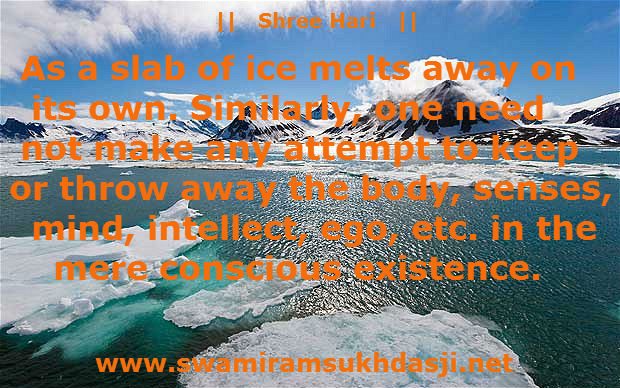
Answer: One has to quieten oneself to merge in the Existent (dominion) by dropping even the demand “let the confined outlook be mitigated”. On being silent, all the behavioral qualities of the mind-intellect-ego cluster mitigate on their own. When a slab of ice is floating on the ocean, one need not do anything particular to melt it away; it melts away on its own. Similarly, one need not make any attempt to keep or throw away the body, senses, mind, intellect, ego, etc. in the mere conscious dominion. On becoming silent or unwavering (nirvikalp), they dissolve away on their own*.

* There is subtle difference between ‘nirvikalpa avasthaa’ (unwavering state) and ‘nirvikalpa bodha’ (unwavering awareness). There is a seeking for action in the unwavering state while there is no seeking for action in unwavering awareness. In other words, the unwavering state belongs to the mind-intellect and the unwavering awareness stays on its own when the relation with the mind and intellect is severed. The silence attained in the unwavering state is not absolute and is bound to end eventually. However, the silence of the unwavering awareness is absolute and can never end. Detachment in the unwavering state also reveals the unwavering awareness.
If you carefully look at the mere Existence (dominion), it is never bound in any manner and is always free. If that is bound then it can never be free and if it is free then it can never be bound. There cannot be any notion of the presence of bondage or absence of liberty. There is just an acceptance of bondage (in us). Once we drop such an acceptance, liberation is ever-established.

Every human is entitled for the knowledge of mere awareness because everyone is equal in its dominion. That dominion is present even amongst the brutal-of-the-most-brutal demons, ghosts, devils, goblins, etc. as much as amongst the kind-of-the-kindest saintly, benevolent, devotional, realized and emancipated ones. The mere consciousness is inseparable from the dominion of the supreme self. One has to just face that dominion. What practice can be there to do that? What effort can be required for that? What hurdles can stop one from that? How can any difficulty pose itself in attaining that? What mystery can hinder one from attaining that?

The mere dominion remains the same even in the most favorable situations as well as in the most unfavorable situations. The same dominion presides the life as well as the death, the ambrosia as well as poison, the heaven as well as the hell, the health as well as the sickness, the knowledge as well as the ignorance, the realized one as well as the ignorant one, the friend as well as the foe, the rich as well as the poor, the strong as well as the weak.


to be continued......

From  Book in Hindi “Tattva Gyaan Kaise Ho?”  by Swami Ramsukhdasji   

Thursday, November 20, 2014

|| Shree Hari ||
What is Knowledge of Reality
(Knowledge of Self or Knowledge of God)
तत्त्वज्ञान क्या है ?
Existence-Sattaa-01.jpg

The self awareness (Aatmagnyaana) and the universal awareness (Paramaatmagnyaana) are synonymous because they both are the same dominion of mere presence that is one. They appear as different from each other only due to the individual opinions. Lord says,

Mamaivaamsho jeevaloke jeevabhootah sanaatanah | (Gita 15/7)

‘The self that enables all the beings in this world has always been essentially an element of my own spirit.’

An individual soul is said to be a fragment (of The Bhagavaan) because of its dependence on the ego which is an element of the world. If it does not latch on to the ego, it is the one mere dominion (existence) as such. Anything other than mere presence (being) is mere imagination. That dominion of mere awareness is the basis of all the imaginations; it enables their very presence; it reveals them; it is their shelter; their very life is granted by That only. In That Dominion, everything is in perfect balance with no traces of bias. The dominion of mere awareness is all-pervasive. Entire creation (objects as well as activities) are incorporated within That. The creation undergoes the cycles of birth and death perpetually; but The Dominion remains as is. Gita says,

Yathaa sarvagatam soukshmyaadaakaasham nopalipyate |
Sarvatraavasthito dehe tahtaatmaa nopalipyate ||  (Gita 13/32)

‘Just like the all-pervasive ether (space) is not tainted, being extremely subtle, so the Self (aatma) permeated everywhere, in the body, is not tainted.’

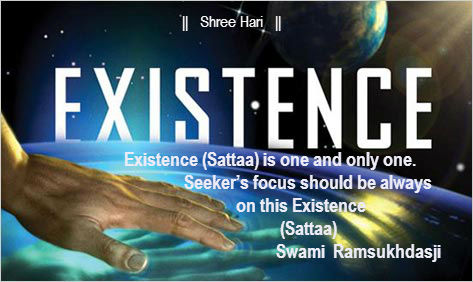
In other words, the mere conscious dominion is not limited to any specific thing such as a body; just like the space, it pervades all the bodies and remains complete in and out of all the creations everywhere. Our true nature is this all-pervasive existence (sattaa, dominione) which is the essence of the supreme self as such. In summary, the existence (sattaa) is one and only one. Seeker’s focus should be always on this existence (sattaa).   

Question: What is the reason for the apparent specificity (localization in one place)  in such an Existence (sattaa, dominion) ?

Answer: One would imagine specificity (localization in one) in the Existence (Sattaa, Dominion of Real) by assuming it to be an object of the intellect or by attempting to characterize it with mind, intellect and ego. In reality, the Existence (sattaa, dominion) cannot be confined in mind, intellect and ego. Actually, it transcends all of them as it remains the basis for their very presence. In the Existences (sattaa, dominion) of mere consciousness, there is no mind, no intellect and no ego.

to be continued......

From  Book in Hindi “Tattva Gyaan Kaise Ho?”  by Swami Ramsukhdasji