|| Shri Hari ||
SHARANAGATI
"Na Vidyaa yeshaam shreern sharanampeeshan cha gunaah
parisyaktaa lokkairapi vrajinyuktaah shrutijadaah
sharanyam yam tepi prasrutgunamaashritya sujanaa
vimuktaastam vande yudupatimaham krushammalam."
parisyaktaa lokkairapi vrajinyuktaah shrutijadaah
sharanyam yam tepi prasrutgunamaashritya sujanaa
vimuktaastam vande yudupatimaham krushammalam."
"He who does not possess any skill, nor wealth, nor has any support; in whom there are no qualities, no knowledge of Vedas, nor of the scriptures; He who has been abandoned by the world being regarded as sinful, such beings too, that take refuge in the One that is the Ultimate Protector, Prabhu (God, Lord), he can become a saint and can attain salvation. I prostrate in front of That One whose qualities have attained recognition around the world, the pure Soul, the father of the Yadu dynasty, Shri Krishna Bhagavaan.
"Sarva Dharmaanparityajya maamekum sharanam vraja
Aham tvaa sarvapaapebhyo mokshayishyaami maa suchah." Gita 18:66
Aham tvaa sarvapaapebhyo mokshayishyaami maa suchah." Gita 18:66
"Abandoning dependence on all duties (dharma), take refuge in ME, alone. I will liberate you from all sins, therefore grieve not. (Gita 18:66)
Comments -
"Sarva Dharmaanparityajya maamekum sharanam vraja" - God says that leave the dependency on all Dharma, the decisions pertaining to Dharma, i.e. also leave the decisions on what to do and what not to do - and take refuge only in ME.
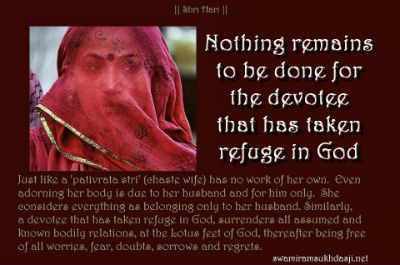
The Self (swayam) is the one that has to take refuge - this is the essence of all spiritual disciplines. Nothing remains to be done for the devotee that has taken refuge in God; just like a pativrata (chaste wife) has no work of her own. Even adorning her body is due to her husband and for the husband only. She does not consider the house, the family, the possessions, the son-daughter and the so called her body too her own, rather considers it to be her husband's (patidev's) only. The point here is that just like a chaste wife merges her gotra (subdivision of same caste group) into the gotra of her husband, thereafter living in husband's home, similarly a devotee who has taken refuge in God, surrenders all assumed and known relations with the body (the caste group, race, name, etc) at the Lotus feet of God, thereafter being free of all worries, fear, doubts, sorrows and regrets.
Here in the Gita, the term "Dharma" stands for Duty. the reason is that from Gita 18-41 to 18:44, the term "Svabhaavaja Karam" (duties born of their nature) have been used. In Gita 18:47 the term "Svadharma" (one's own duty) has been used and again in Gita 18:47 and 18:48 the term "Karma" (Duty) has been used. It means that in this context at the beginning and the end the term "Karma" (Duty) has been used, while in the middle the term "Svadharma" (one's own duty) has been used, therefore the term "Dharma" stands for "Duty".
Now the question arises from the words "sarvadharmaaparityajya" whether in essence, one's "dharma" i.e. "duty" should be understood to be abandoned ? The answer is that it is actually not proper to abandon one's duty, nor does this fit well with the current topic and the relevance to it. Arjuna on listening to this point from God did not foresake his duties, rather he said "Karishye vachanam tava" (Gita 18:73) - "I shall act according to your word", and accepted to obey and follow the instructions given by the Lord to fulfill his duties. Not only did he accept, but he carried out his order and waged war.
From "Sharanagati" in Hindi by Swami Ramsukhdasji.
Ram Ram